
Can AI Help Tax Teams? Where AI Helps and Where Human Judgment Matters
AI can accelerate research, surface insights, and reduce manual effort, but tax professionals remain essential for interpretation, risk assessment, and final tax decisions.

Artificial intelligence is changing how businesses work. Marketing teams use AI to draft content. Customer service teams use it to answer questions. Finance teams use it to analyse data. So naturally, tax teams are asking: Can AI help with tax, too?
The answer is yes. But tax is different from many other business functions. While AI can help automate repetitive tasks, accelerate research, and identify patterns in data, some tax decisions still require human expertise and oversight. The challenge is knowing where AI can help your team and where your expertise is still needed. Here's how organisations should think about AI in tax today.
Why Is AI Different in Tax Than in Other Business Functions?
Many business processes can tolerate small mistakes. An AI-generated social media post can be edited before publication. A marketing email can be reviewed before it's sent. Even if an AI tool makes a mistake, the impact is often limited. Tax is different.
Tax decisions affect your financial reporting, compliance obligations, audit readiness, and business risk. A mistake can lead to underpayments, overpayments, penalties, interest assessments, or costly remediation efforts for your organisation. Tax decisions also need to be explainable and defensible if questions arise later.
That doesn't mean tax teams should avoid AI. It means you should approach AI differently. The goal isn't simply to automate more work. It's to help your team move faster without introducing unnecessary risk.
What Tax Tasks Are Good Candidates for AI?
If you're evaluating where AI can add value in tax, these are some of the most practical places to start:
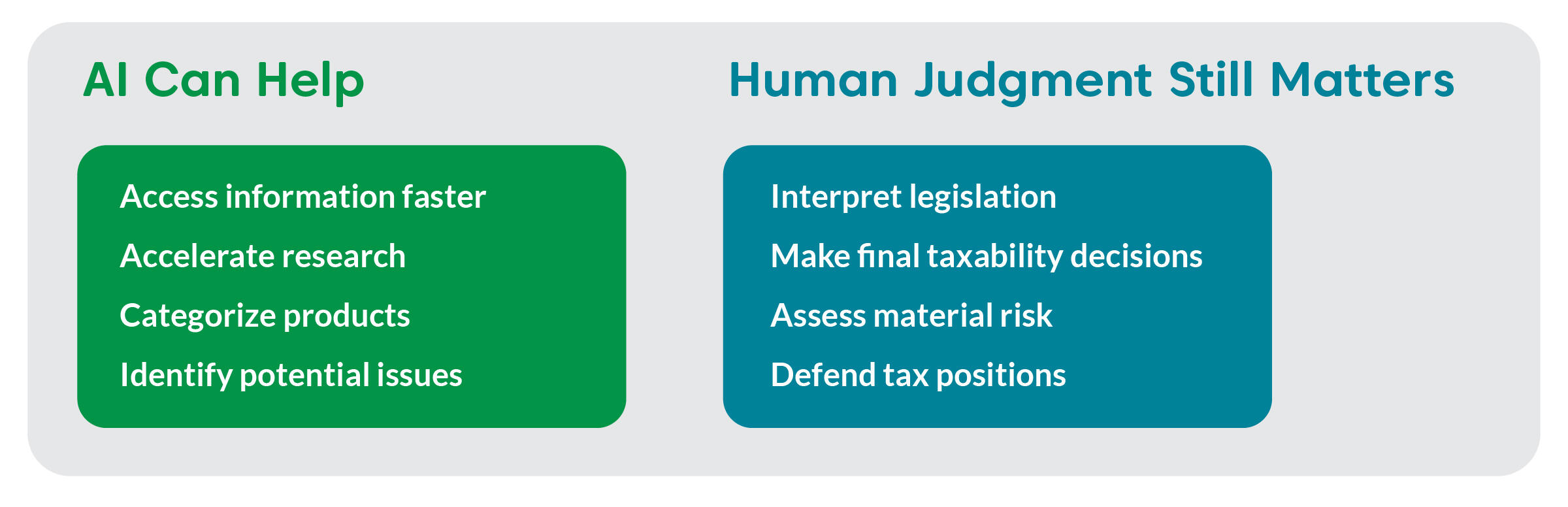
- Accessing tax information faster: AI assistants can help users locate documentation, product information, support resources, and workflow guidance more quickly. Instead of searching across multiple systems and resources, you can access information within the context of your existing workflows.
- Tax research and content navigation: If your team spends hours reviewing regulations, guidance, and legislative updates, AI can help surface relevant information and accelerate research workflows. This means you can spend more time evaluating what the information means for your business and less time searching for answers.
- Product categorisation: If you manage a large and constantly changing product catalog, product categorisation can become difficult to maintain at scale. AI can review product information and suggest how products should be categorised for tax purposes, helping reduce manual effort while keeping your team in control.
- Identifying potential risks: AI can help surface unusual patterns, identify potential taxability concerns, and prioritise areas that may require review. Rather than manually scanning large volumes of transactions, your tax team can focus their attention on the issues that may have the greatest business impact.
Which Tax Tasks Still Require Human Oversight?
AI can assist with tax work. But it should not replace your professional judgment. Tax regulations are complex. Laws continue to evolve. Business situations often involve facts and circumstances that require interpretation. As a result, certain activities should continue to require human judgment:
- Interpreting new legislation: AI can summarise legislation and regulatory updates, but you must determine what those changes mean for your business.
- Making final taxability decisions: AI may be able to recommend a tax treatment based on available information, but you should maintain oversight of final decisions, especially when significant financial or compliance risk is involved.
- Assessing material risk: AI can highlight potential issues, anomalies, or changes that may require attention, but you must decide which risks matter most and what action should be taken.
- Defending tax positions: If auditors have questions about a tax position, someone on your team—not AI—must be able to explain and defend it.
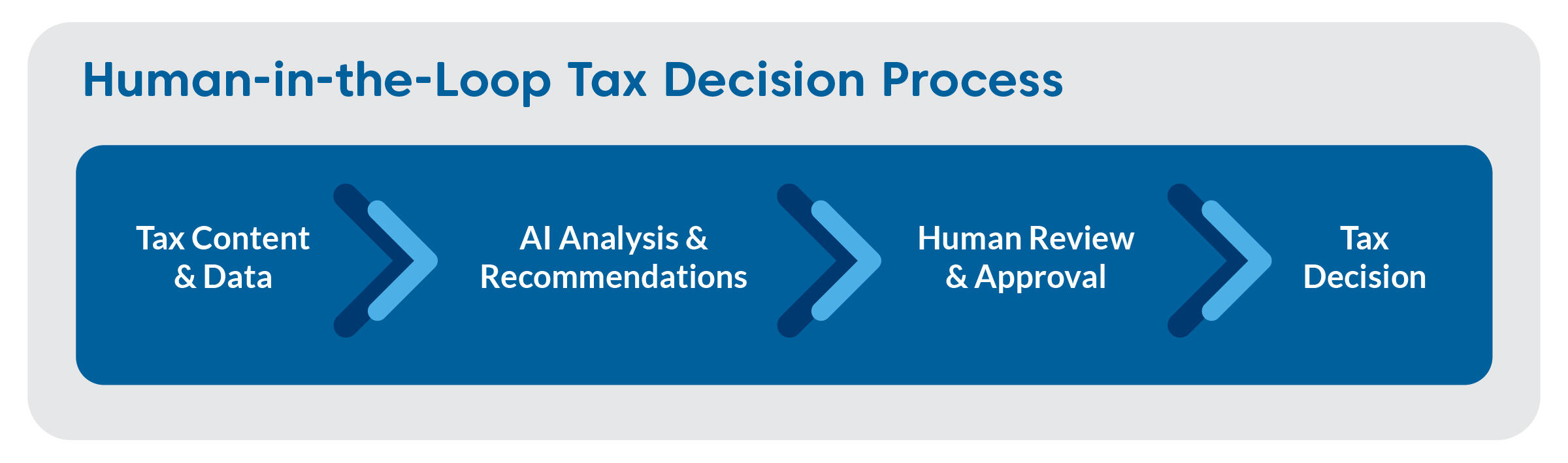
These are some of the reasons many organisations adopt a "human-in-the-loop" approach to AI. In this model, AI assists with research, analysis, and recommendations, while people remain responsible for reviewing, approving, and acting on the results.
What Should You Look for When Evaluating AI for Tax?
As you evaluate AI solutions for tax, it's important to understand both the risks and the safeguards that can help address them.
- Trusted tax content: Tax regulations change frequently. AI is only as reliable as the information behind it. When evaluating AI solutions, look for tools that use trusted tax content and are designed to keep pace with regulatory change.
- Transparency and explainability: If an AI system makes a recommendation, you should be able to understand how that recommendation was generated. The more visibility you have into how decisions are made, the easier it becomes to validate and trust the results.
- Human oversight: AI should support decision-making, not replace it. You should remain involved in reviewing, validating, and approving important tax outcomes.
- Governance and accountability: Even when AI is involved, accountability for tax decisions remains with your organisation. AI should operate within established controls, review processes, and governance frameworks.
- Security and privacy: Before adopting any AI solution, you should understand how your data is handled, protected, and used. This is especially important when working with financial and tax-related information.
How Should Organisations Think About AI in Tax Going Forward?
As you evaluate AI for tax, the goal shouldn't be to automate every decision. The goal should be to identify where AI can support your team while keeping people responsible for the decisions that matter most.
The most effective approach is to use AI where it can reduce manual effort, accelerate research, or surface insights, while relying on human judgment for decisions that require interpretation, accountability, and oversight.
AI can help with tax. But human judgment still matters.
Explore AI for Tax
The most effective AI solutions help tax teams work more efficiently while maintaining human oversight. Learn how Vertex is applying AI across tax workflows to help teams accelerate research, reduce manual effort, and maintain human oversight of important tax decisions.
Disclaimer
Please remember that the Vertex blog provides information for educational purposes, not specific tax or legal advice. Always consult a qualified tax or legal advisor before taking any action based on this information. The views and opinions expressed in the Vertex blog are those of the authors and do not necessarily reflect the official policy, position or opinion of Vertex, Inc.
Put AI to work for global tax compliance
AI-powered automation operates directly within the Vertex Cloud platform to support indirect tax determination, e-Invoicing, global compliance reporting and file & pay workflows.
Learn More